Wings Over Alma, the nature and art center on Main Street, says plainly why the town's famous swan lake has gone quiet. Tundra swans once gathered by the thousands at Rieck's Lake Park and up the Buffalo River to Tell Lake along Hwy 37, and the center writes that Alma can "no longer boast such numbers" because the swans' "food source" is "no longer being prevalent in our area." Wings Over Alma's nature page goes on to name the plants that disappeared. Those plants explain where the swans went, and they decide where a family should drive this holiday weekend.
People driving north on Hwy 35 still see the observation decks at Rieck's Lake Park and assume the swans are there. The park is still worth the stop. Finding the swans now means following the food.
What Rieck's Lake Used to Feed
Tundra swans stop on the Mississippi to eat before flying on toward Chesapeake Bay. Their main foods are arrowhead root bulbs, also called duck potato, along with wild celery and sago pondweed. Rieck's Lake sits two miles north of Alma, off Wisconsin Hwy 35, where the Buffalo River meets the Mississippi backwaters. For a long stretch it had plenty of all three. Midwest Weekends reports that as many as 6,000 tundra swans once came to the lake in a fall. Wings Over Alma's own figure is up to 5,000.
According to Wings Over Alma, flocks that size ate the arrowhead, wild celery and sago pondweed faster than the plants could recover, and then an invasive marsh grass took over Rieck's Lake. Midwest Weekends points to sediment from the Buffalo River, carried in faster by floods, which filled the slough until burr reeds largely replaced the tubers. The Wisconsin Society for Ornithology says silting of Rieck's Lake eliminated the arrowhead tubers the tundra swans favored, and that swans bound for the Atlantic coast now feed farther south near Goose Island in La Crosse.
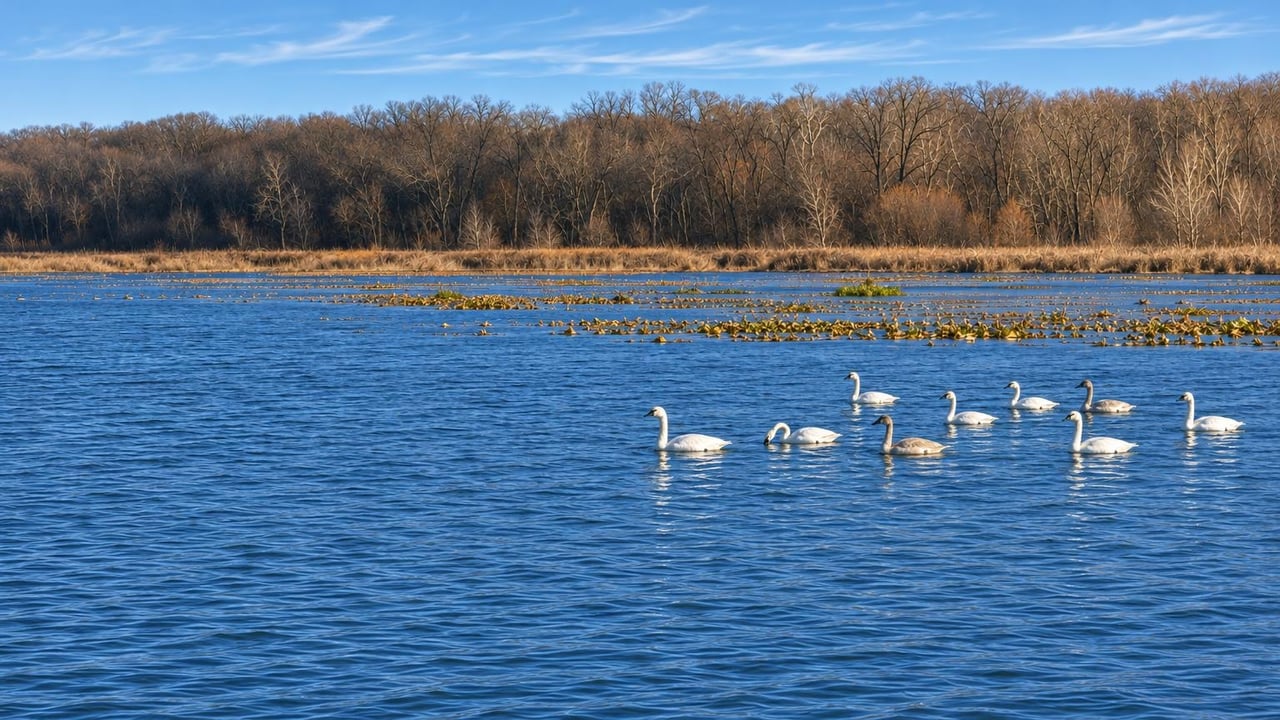
With the plants mostly gone from the lake, most of the swans are gone too. Explore Alma still lists Rieck's Lake as a place to see swans, in smaller numbers than the hundreds it once drew, alongside other ducks, waterbirds and cranes. Wings Over Alma counted about 20 swans at a time on the lake in fall 2019, and it says the numbers change every year.
Where the Swans Are This November
The Upper Mississippi River National Wildlife and Fish Refuge keeps a recent-sightings page during fall migration. It shows that the swans on this stretch of river have shifted to a few places, and that the birds themselves have changed.
The closest large group to Alma is at Weaver Bottoms, across the river in Minnesota, in Pool 5. The refuge's best swan-viewing spot there is the 116th Avenue service road beside MN Highway 61 near St. Mary's Cemetery, about 17 miles north of Winona. On October 31, 2026, the refuge counted 75 to 100 swans in the Weaver Bottoms marsh near the frontage road and cemetery. Most were trumpeter swans, with some tundras mixed in. The same count found 5 to 25 bald eagles, 2,000 to 4,000 ring-necked ducks and 4,000 to 6,000 dabbling ducks in the marsh.
Downriver, the counts drop off. On November 5, 2026, the Brownsville Overlook, about three miles south of Brownsville, Minnesota, off MN Hwy 26, had 12 trumpeter swans with a few tundras among them. The Hwy 26 Overlook, half a mile farther south, had six trumpeters. Shady Maple Overlook, south of La Crosse off Hwy 35, had none. Brownsville is worth the drive for ducks even without many swans. That same November 5 count estimated 20,000 diving ducks there, mostly ring-necks near the deck and canvasbacks out by the main channel. The overlook also has two spotting scopes.
Thanksgiving falls on November 26 this year, about a week past the usual peak. The refuge says the tundra swan migration typically peaks in the second or third week of November, and that many birds stay until the Mississippi freezes. If the river freezes fast, the birds crowd into whatever open water remains. If it freezes slowly, they stay spread out. So you may well see swans this weekend, but they could be in large groups or scattered, depending on the ice. The refuge updates each site only when staff or volunteers have time. It also takes sightings from the public at [email protected], so if you see swans this weekend, you can send in a count yourself.
Telling a Trumpeter From a Tundra
Most of the swans at Weaver Bottoms this fall have been trumpeters, so the bird you see may not be the one Alma was known for. The Wisconsin DNR says the two are easy to mix up because both are white with black bills. Tundra swans often have a small yellow spot in front of the eye, and trumpeters have a heavier, wedge-shaped bill and head. The DNR says the call is the most reliable way to tell them apart. A trumpeter's call is deep and resonant, while a tundra's is higher and quavering. The DNR also warns that bill markings are not always typical. Some tundras show a red edge on the bill, and some trumpeters have the yellow spot.
Trumpeters have a local angle too. Wings Over Alma calls them rare around Alma but notes that some stay through the winter, so a swan seen near town in January is more likely a trumpeter than a tundra.
A Holiday Loop That Starts and Ends in Alma
A swan drive from Alma works best as a loop, and a kitchen-table map is enough to plan it. Start on Main Street at Wings Over Alma Nature & Art Center, 110 N Main Street. The center lists its hours as Thursday through Sunday, 11 a.m. to 4 p.m., and asks visitors to call 608-685-3303 before coming. Calling matters more than usual this week, since the first day of the weekend is Thanksgiving. Its outdoor deck has spotting scopes and binoculars and looks out over the Mississippi and Lock & Dam 4.
The deck matters more each week from now on. When the river freezes in the coldest part of winter, the open water just below Lock & Dam 4 stays clear. Bald eagles gather there to feed, and the center says you can watch them straight from its deck. The Alma Chamber of Commerce puts that eagle season at December through March, and the center has had winters with hundreds of eagles at once. If you stop on Thanksgiving weekend, you will be there just before the eagles arrive in numbers.
From Main Street, drive up to Buena Vista Park, a city park about 500 feet above town off County Road E. It is open daily from dawn to 11 p.m. and looks for miles up and down the river. The Chamber lists wintering bald eagles among the fall raptors seen from the park. On a clear afternoon, you can follow the river north toward Rieck's Lake and the Buffalo River from up there.
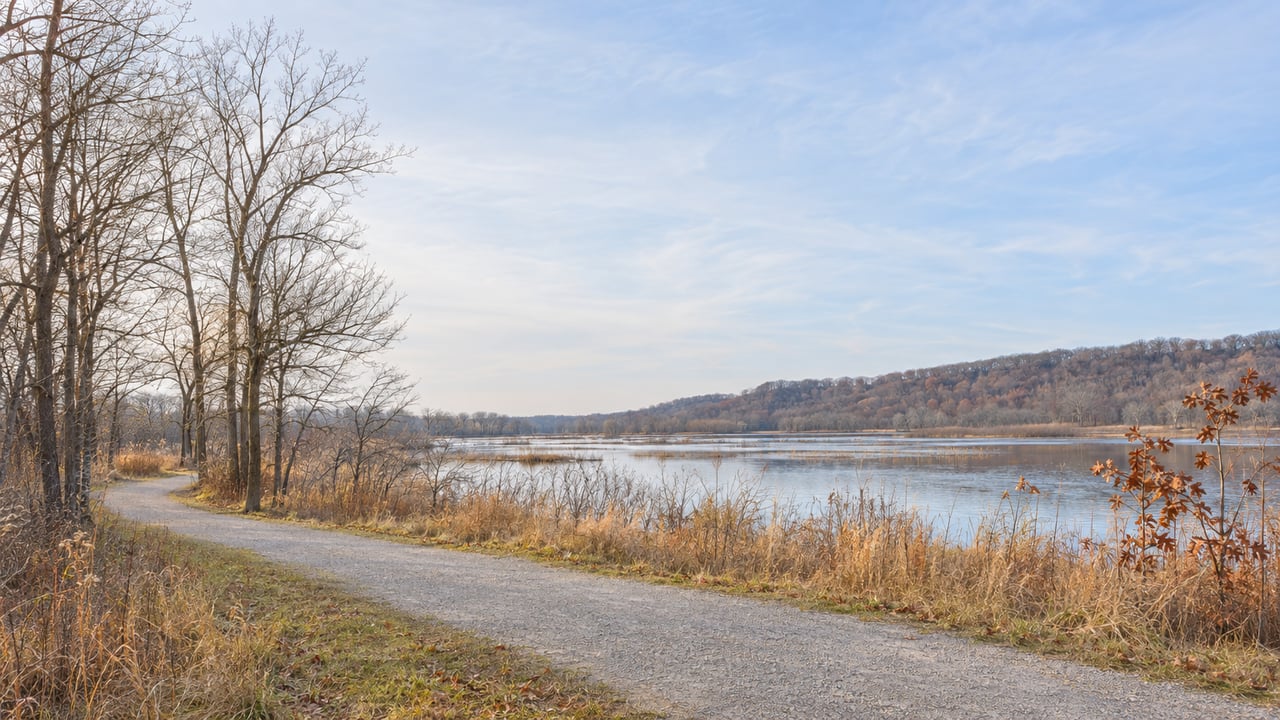
Then go north on Hwy 35 to Rieck's Lake Park itself. It has two wildlife observation decks, open-roofed shelters and history and nature kiosks about the lake. Brekow's Landing, at the north end of town by the park, is where paddlers enter Beef Slough by way of the Buffalo River. Wings Over Alma says migrating tundra swans may turn up near Beef Slough. The slough runs through the DNR's Tiffany Wildlife Area, a public property of about 13,000 acres along the Chippewa River in Buffalo and Pepin counties. Beef Slough was busy long before birders came. It was a slow Chippewa River channel used to collect floating logs, and the Wisconsin Historical Society's record for the Alma Historic District says Alma logging companies took five billion board feet of timber through it between 1867 and 1889.
If you have time, Hwy 37 follows the Buffalo River valley for 20 miles up to Mondovi. The Wisconsin Society for Ornithology says many swans gather upstream at Tell Lake, which you can see from Hwy 37, and that the far side of Rieck's Lake, along County Road I and Badland Road, can give a better view than the platform by Hwy 35. If you want the bigger group of swans, cross the river and drive down Highway 61 to the Weaver Bottoms service road. Then come back to Alma to warm up.
The Burlington Hotel's bar is open year-round and serves coffee, tea and hot chocolate along with drinks. Its website lists Friday and Saturday bar hours of 5 to 10 p.m. North of town, Walker's Silvermoon at S1582 State Road 35 serves dinner on weekends. Its website posts more than one set of kitchen hours, so call before you drive up. Over the holiday weekend, call either place before you go.
If you have friends in Buffalo County, our recent look at Fountain City's Main Street covers the next river town south. Our Buffalo County page covers the rest of the county.
Bluff land, Mississippi backwater frontage and the small river towns along Hwy 35 are some of the most distinctive property in the Chippewa Valley, and each parcel is a little different from the next. If time along the river this weekend has you thinking about owning land or a home in Buffalo County, Wanda Johnson has more than 30 years of experience with rural and waterfront property here and is glad to talk through what is out there. Work With Wanda by scheduling a consultation.